 Our trek started leisurely, we stopped for coffee at Vatakanal where hoardes of post-military-service-Israelis were encamped along with a guy from Ludlow before an auspicious mountain view. Eucalyptus plantations shot skyways from precarious slopes and our track wound down to a remote mountain village where we had another freshly grown grown coffee. The village was both beautiful and friendly although the chap who served us coffee from his kitchen stove seemed in a rush to get away.
 Half way down our momentous descent, we stopped by a Tree Temple and chatted via our guide with three village farmers, one of whom was our keen-toget-away coffee host. The ground level of the forestry up in the Western Ghats is leased for free to villagers prepared to live with minimal facilities and no roads up in the mountains an dthey put it to great use. Our shade-seekers at the temple were bringing down 25Kg sacks of super-fresh beans and cardamom pods. These green delights were expected to make 350 rupees a kilogram at wholesale market prices that day and so the arduous task of bringing them down to the town was going to send them home with about 120 GBP. I hadn't given much thought to how they were carrying their sacks but as we passed further down the rocky path, I winced at the fact that all of this weight was being carried on their heads and these were not young men either.
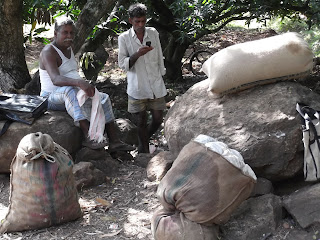 In the mango plantation (sadly these beautiful fruits are still only flowers at this time of year) at the base of the track, our guide called for an Auto to collect us and asked if we minded sharing it with the farmers and the produce when they got down. Absolutely not! As well as their enormous cargo each of the farmers had a shopping bag over their shoulder and as they reached the mango trees (incredibly only about 20 minutes after we did!) they shot off to the waterpipe with their shopping bags. Out of the mango grove returned three freshly scrubbed businessmen combing their hair and making mobile phone calls. Gone were their faded and patterned dhotis and vests; these industrious villagers were now walking tall in bright white dhotis and crisp white short sleeved shirts. After the phone call I sensed their moods lift further than their shower had provided and on enquiring with the guide we discovered that there had been a real shortage of cardamom and the Kg price had risen to 750 today. That made the precious cargo worth about 250 GBP!! With huge smiles we shared the delights of this well timed economc phenomen and piled into the auto making sure that the cardamom sack got the safest seat!

 |
| Pepper |
We descended 2000m of rough terrain on day one and given that we were set to conclude day two on the mountain top border of Tamil Nadu and Kerala, day 2 was always going to be daunting. I sensed dead areas in my quads despite a concerted stretching session in the mango grove, but regardless, Mr Sekar was convinced that we were fit enough to take on the mountain at trot. I found myself slipping behind the men. I never find this when I am walking normally and I worked hard in my mind to park self-punishing thoughts induced by my rather obsessive consumption of Idly, Dosa and Pongal. Incidentally I do hope to name pets after these south Indian culinary delights at some point in my life! Despite walking several kilometers each day I just didn't feel as fit as I was when I left home. The heat, the hassle and fact that most Indians can't grasp why we might choose to walk when we could get an auto/bus/rickshaw had relieved me of the opportunity for aerobic excercise. I was struggling, Jean luc pointed out at one point that we were also were not getting any younger. Noted.
 Meanwhile some stunning paths, views, flora and cloud formations were unfolding around our never-ending ascent. Shade was scant and as such so were breaks, and I really needed some more breaks but I was driven by the odd notion that it mattered to keep up with a man who does this two or three times a week. As the tracks waned and tiny vertigo inducing goat paths prevailed, the fact that I had not worn shoes for a month tore right into my heels which I just managed to cover in compeed patches before chronic blistering set-in.
 |
| Cotton |
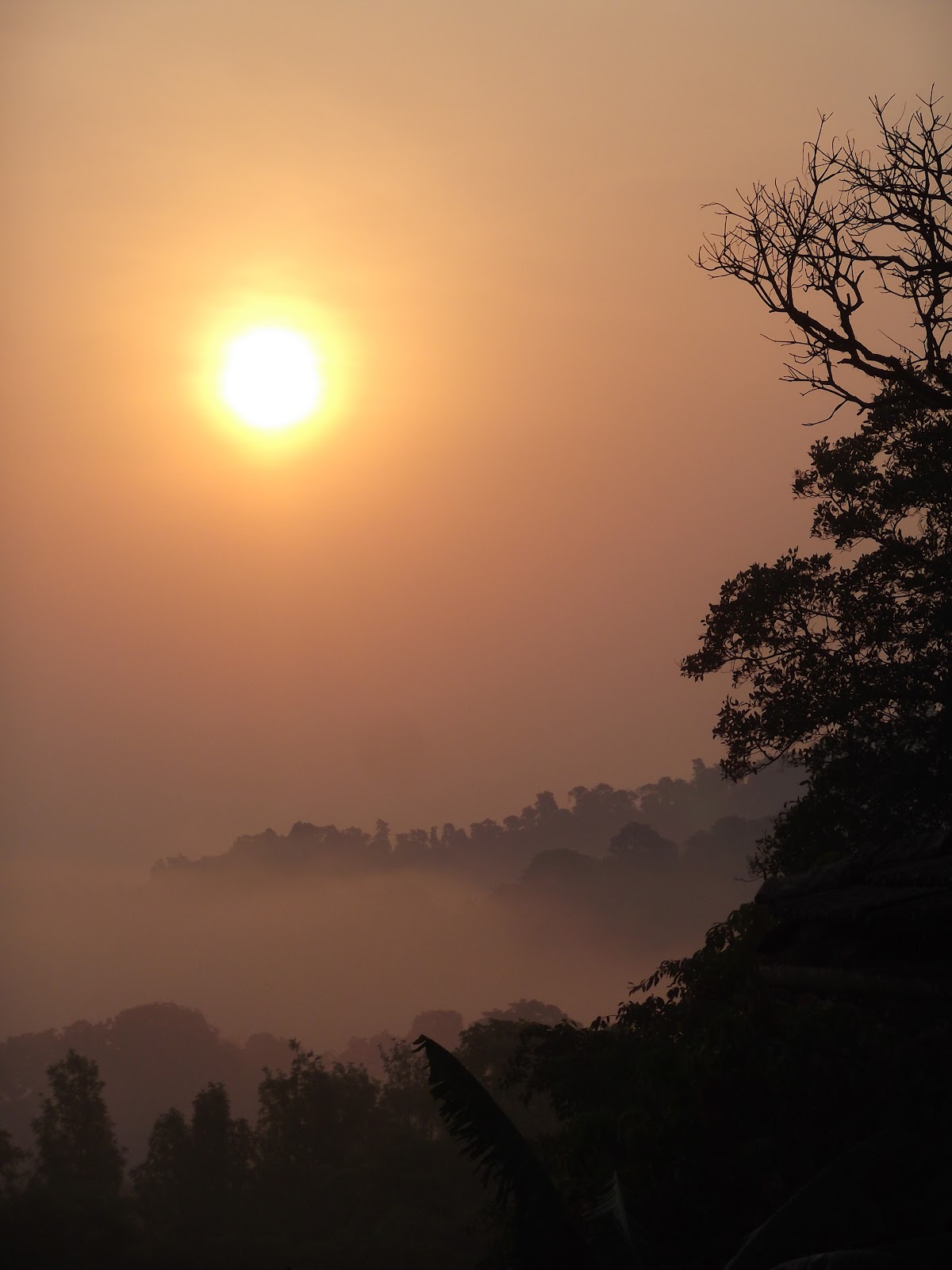
As cream permeates coffee, cloud poured over the ridge and dissipated via white tendrils before settling evenly into the atmosphere around us, occasionally the tendrils would peel back to reveal a glimpse of our summit, we even saw human form up there from time to time and I was buoyed by the thoughts of the top, of food …of stopping. When it felt as if we were within an arm’s length of the top, the now wider track took a wide swoop to our right and zig zagged endlessly up an adjoining valley. Emotionless I registered this disappointing reality and told my legs that at least it wasn't going to be steep anymore. That was point at which Mr Sekar climbed up off the track to the left delightedly explaining that we were so strong we would be able to go the more interesting route adding how much he enjoyed being with "strong walkers" for the opportunity they gave him to take the fun alternative to that long zig zag to our right.
The 30 minute scramble through waist high, razor-edged grasses on what I think was the steepest (although I didn't look down) mountainside I have ever attempted without a rope and harness proved to be a heady mix of exhilaration, exhaustion and epilation. Never have I been so happy to arrive, quivering and covered in tiny cuts at the top of a hill.
Typically we were not actually at the top and had a brutal 500m of man-made steps to climb which were covered with the added insult of incredulous bus tripping tourists. Eventually our sweat soaked bodies collapsed in happy heaps at the roadside restaurant where Mr Sekar's friend presented us with a not-quite-big-enough veg Thali.


|
| Tea Plantations on the Run back to Munnar |
Call Mr Sekar on 9865214479




 When Steve landed
in India, I think my whole body sensed the arrival of a support network and packed
up having to look after itself.
Following internet research and antibiotics we now believe that I either
have Giardia or my tummy has been so assaulted that it is now highly
sensitised. The culprits are dairy,
spice and fat so I am on a pretty boring diet right now but it seems to be
working. Anyway, I digress …the tummy
has had somewhat hampered our trekking plans since reaching the plantations but
whilst at Palace, we managed to achieve our aim of climbing Kodagu’s highest peak
…Tadiyendamol. The walk was only as
challenging as a day’s summit-bagging in the lakes but we had the whole range
almost to ourselves, the rain held-off and we didn’t come face to face with
wild tigers or elephants …although we did see wild elephant poo in a rather
enclosed corner of the reserve!
When Steve landed
in India, I think my whole body sensed the arrival of a support network and packed
up having to look after itself.
Following internet research and antibiotics we now believe that I either
have Giardia or my tummy has been so assaulted that it is now highly
sensitised. The culprits are dairy,
spice and fat so I am on a pretty boring diet right now but it seems to be
working. Anyway, I digress …the tummy
has had somewhat hampered our trekking plans since reaching the plantations but
whilst at Palace, we managed to achieve our aim of climbing Kodagu’s highest peak
…Tadiyendamol. The walk was only as
challenging as a day’s summit-bagging in the lakes but we had the whole range
almost to ourselves, the rain held-off and we didn’t come face to face with
wild tigers or elephants …although we did see wild elephant poo in a rather
enclosed corner of the reserve!


